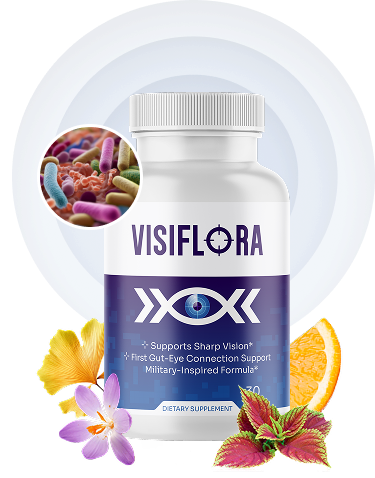
VisiFlora review: the quick take
VisiFlora is a broad eye-nutrition supplement built around two ideas: familiar eye nutrients such as lutein, zeaxanthin, zinc and antioxidant vitamins, plus a larger botanical blend positioned around a “gut-eye connection.” The current label supports the fact that these ingredients are present, but it does not disclose individual doses for the 14 ingredients in the proprietary blend.
The strongest reason to examine VisiFlora carefully is not a single marketing claim. It is the label structure. Seven nutrients have exact amounts, while the rest share a 351 mg total. That makes the formula easy to identify but harder to compare ingredient-by-ingredient against published research or transparent competitors.
What the current label actually shows
| Label component | Current amount per 1-capsule serving |
|---|---|
| Vitamin A (as beta carotene) | 450 mcg RAE |
| Vitamin C | 90 mg |
| Vitamin E | 15 mg |
| Zinc | 11 mg |
| Selenium | 20 mcg |
| Copper | 0.9 mg |
| Chromium | 15 mcg |
| Proprietary blend | 351 mg total across 14 listed ingredients |
The blend lists taurine, ginkgo biloba leaf, eyebright, grape seed extract, coleus forskohlii root, alpha lipoic acid, rutin, quercetin, bilberry fruit extract, saffron extract, lycopene, lutein, zeaxanthin and astaxanthin. The label does not assign an individual dose to any one of these fourteen.
How the evidence should be interpreted
Several VisiFlora ingredients have legitimate roles in nutrition or have been studied in eye-health contexts. That does not automatically validate the finished product for a specific disease or outcome. Product-level evidence depends on the exact formula, doses, population and study design.
One useful benchmark is AREDS2. The National Eye Institute studied a specific combination of vitamin C, vitamin E, copper, zinc, lutein and zeaxanthin in people with defined stages of age-related macular degeneration. VisiFlora is not that formula. Its disclosed vitamin C, vitamin E, zinc and copper amounts are different, and its lutein and zeaxanthin doses are not individually stated.
The merchant’s “gut-eye” framing is better treated as a research theme than a proven product mechanism. Research into links among the gut microbiome, systemic inflammation and ocular conditions is active, but that does not establish that this particular combination prevents or treats eye disease.
Current offer structure
On September 21, 2026, the merchant page displayed three purchase tiers: 2 bottles at $79 per bottle ($158 total, plus a small shipping fee), 3 bottles at $59 per bottle ($177 total, with free U.S. shipping stated), and 6 bottles at $49 per bottle ($294 total, with free U.S. shipping stated). The page also advertised three digital bonus guides and a 60-day money-back guarantee. Offers can change, so the checkout is the controlling source at purchase time.
Safety context that matters
The label advises adults to take one capsule daily and says not to exceed the recommended dose. It also tells people who are pregnant or nursing, taking medication, or managing a medical condition to consult a physician before use. Because the formula includes multiple botanicals, medication and supplement overlap is a practical reason to review the full label with a clinician or pharmacist.
VisiFlora also contains vitamin A as beta carotene. The National Eye Institute specifically advises current and former smokers to avoid the older AREDS formula containing beta-carotene and to use the beta-carotene-free AREDS2 formula when AREDS2 is indicated. That evidence was generated with the AREDS context and does not establish the risk of VisiFlora’s lower beta-carotene amount, but the ingredient is still important to flag for current or former smokers.
Who might find VisiFlora’s format appealing?
- People who prefer a once-daily capsule rather than multiple daily softgels.
- People specifically interested in a broad blend that combines carotenoids, vitamins, minerals and botanicals.
- People comfortable with a proprietary blend where many individual doses are not disclosed.
People with diagnosed AMD or other eye disease should not treat a general supplement comparison as a substitute for disease-specific guidance. If an eye-care professional has recommended AREDS2, compare the exact studied formula rather than using ingredient-name overlap alone.
Sources checked: current VisiFlora sales page and current label image on the merchant contact page; National Eye Institute AREDS/AREDS2 materials. Checked September 21, 2026.